Showing posts with label Engine Technology. Show all posts

AUDI ADDS 354 DYNAMIC HP GASOLINE ENGINE FOR SQ5

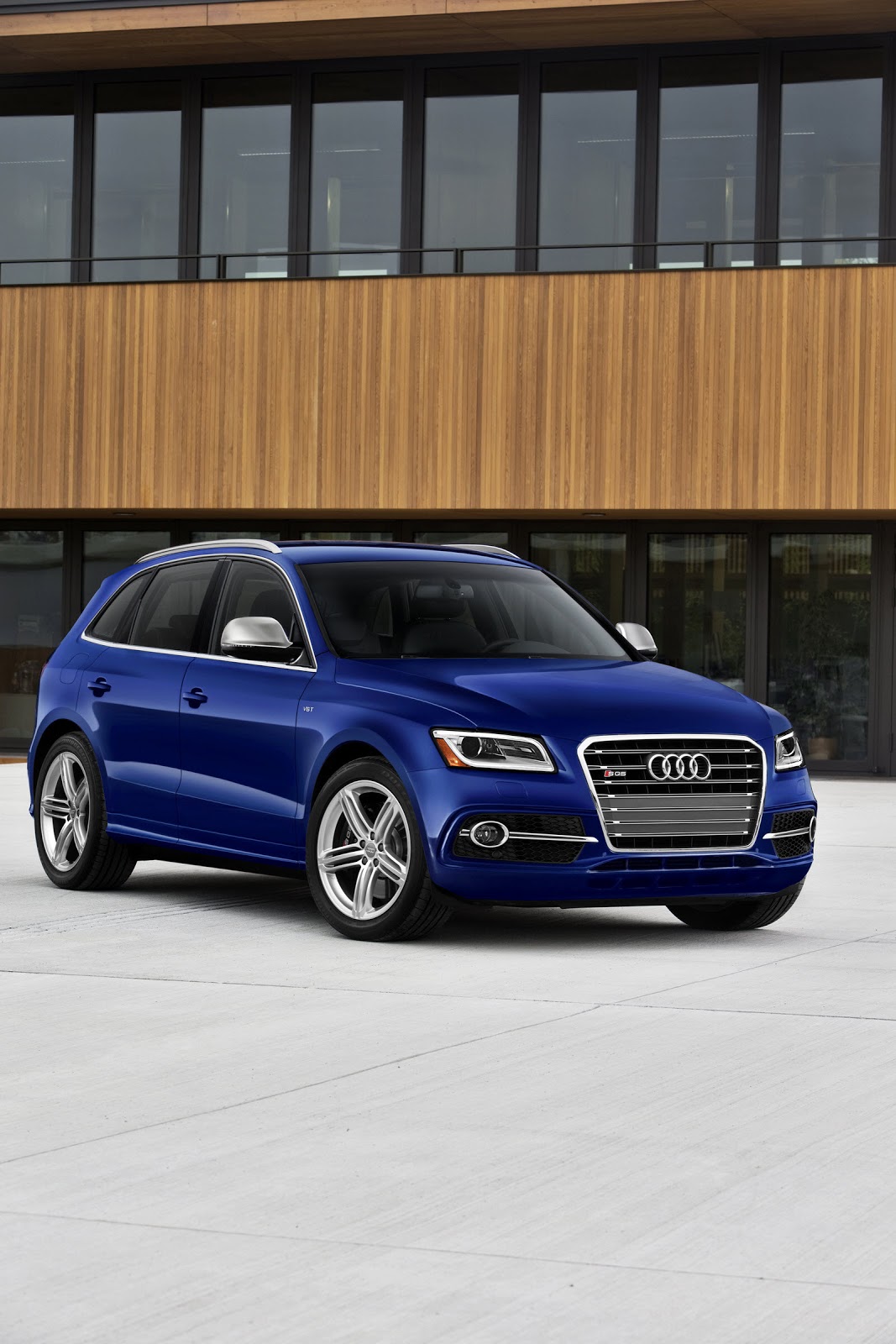
2014 Audi SQ5 3.0 TFSI

• SQ5 with 3.0 TFSI engine at the Detroit Auto Show
• From zero to 100 km/h (0-62 mph) in 5.3 seconds
• 250 km/h (155 mph) top speed

The new Audi SQ5 shown at the Detroit Auto Show is the first ever to be powered by a gasoline engine – in this case one producing 260 kW (354 hp) and 470 Nm (346.65 lb-ft) of torque The new top-of-the-line model, which was designed specifically for markets such as the United States, Canada and China, uses a 3.0 TFSI engine with forced induction. It sprints from zero to 100 km/h (0-62 mph) in 5.3 seconds on its way to a top speed of 250 km/h (155 mph). 

3.0 TFSI V6 engine


The new SQ5 is powered by a free-revving, supercharged, three-liter V6 engine with a displacement of 2,995 cc. Its compressor sits in the 90-degree V of the cylinder banks and is belt-driven by the crankshaft. Two rotors inside the supercharger spin at over 20,000 rpm. The air gap between them is just a few thousandths of a millimeter. The supercharger compresses the intake air to as much as 0.8 bar; two intercoolers then cool it for greater power.

The compressor is located downstream of the throttle valve. Its drive requires little engine power, as the density of the intake air is very low at loads below the supercharging level and when coasting. Torque develops early and quickly due to the short gas paths downstream of the supercharger. Various measures dampen compressor noise. A balance shaft in the engine’s alloy crankcase provides for greater smoothness. Adjustable intake camshafts and flaps in the intake ports provide for good charging efficiency in the combustion chambers.

The 3.0 TFSI engine produces 260 kW (354 hp) between 6,000 and 6,500 rpm, and delivers 470 Nm (346.65 lb-ft) of torque to the crankshaft between 4,000 and 4,500 rpm. The sprint from zero to 100 km/h (0-62 mph) takes just 5.3 seconds – best in its class. Top speed is electronically limited to 250 km/h (155 mph). The Audi SQ5 consumes on average 8.5 liters of fuel per 100 km in the NEDC (21 US mpg). This equates to CO2 emissions of 199 grams per kilometer (320.26 g/m) in the NEDC.

An eight-speed tiptronic and quattro permanent all-wheel drive with torque vectoring transfer the power of the SQ5 firmly to the road. The fast-shifting automatic transmission offers two modes, and the driver can also switch gears manually via the standard shift paddles on the steering wheel.

The chassis of the Audi SQ5 lowers the body 30 millimeters (1.18 in). The springs and shock absorbers are more tautly tuned for a sporty and balanced setup. The 20-inch wheels are fitted with 255/45-series tires; 21-inch wheels are available. The brake calipers on the front axle sport the SQ5 badge. The electromechanical steering not only plays a major role in the efficiency of the SQ5, it also provides very precise road feel. Audi also offers the optional dynamic steering with a steplessly variable ratio. Control of it is integrated in the optional Audi drive select system, which allows the driver to switch among several modes in various systems.

The platinum gray radiator grille with its horizontal double bars in aluminum look, the distinctive bumpers and the roof spoiler are particularly eye-catching. V6 T badges adorn the front fenders. The gloss package and exterior mirrors in aluminum look accentuate the windows. In addition, there are two exclusive crystal-effect finishes: Estoril Blue and Panther Black.

Sportiness carries over to the interior. The instruments feature gray dials and white numerals; the pedals and shift paddles have a shiny aluminum-look finish.

The interior is bathed in black, with the headlining optionally available in Moon Silver. The standard power-adjustable sport seats are covered with a combination of Pearl Nappa leather and Alcantara, with four different colors of leather optional. The standard inlays are brushed aluminum. Options include Carbon Atlas, Piano finish or layered aluminum and wood in Beaufort black.

The SQ5 is scheduled to arrive at U.S. dealerships in the third quarter of 2013. The list of standard equipment is extensive. In addition to the aforementioned features, there are also xenon plus headlights with LED daytime driving lights, a stainless-steel loading-sill protector and a driver information system with color display. The luggage compartment offers up to 1,560 liters (59.33 cu ft) of capacity.

Audi can supply this dynamic SUV with an array of optional assistance and infotainment systems. MMI navigation plus and the Bluetooth online car phone provide the Internet services from Audi connect to the vehicle.

The Audi SQ5 has been designed specifically for the following markets: United States, Canada, Russia, China, Japan, Singapore, South Korea, South Africa, Mexico, Brazil, Argentina, Chile and the Ukraine. In Germany and many other European markets, the SQ5 TDI takes its place as the sporty top model in its series.

Images : 2014 AUDI SQ5


[Source : AUDI]

BMW TwinPower Turbo Technology for X3 and X5

2012 BMW X3 xDrive28i

MUNICH : February 13, 2012 - Dynamic handling characteristics are still the trademark of BMW’s Sports Activity Vehicles. In each of their segments both the BMW X3 and the BMW X5 are seen as the benchmark for agility and driving pleasure. In the spring of 2012, the sporting character of the two BMW X models will be further underscored by innovations added to the range of engines and equipment features. A new and particularly powerful engine for the BMW X3 xDrive28i, Driving Experience Control for individual vehicle settings for all variants of the BMW X3 and the M Sport Edition of the BMW X5 ensure targeted optimisation of sporting qualities.

Furthermore, the choice of optionally available driver assistance systems featured by BMW ConnectedDrive is being further extended for the BMW X3.

BMW 4-cylinder petrol engine with  TwinPower Turbo

New BMW X3 xDrive28i: Faster sprint, better fuel economy thanks to BMW TwinPower Turbo Technology.

Starting in the spring of 2012, all BMW X3 model variants will be powered by engines equipped with BMW TwinPower Turbo Technology. The latest addition to the drive train portfolio is the 2-litre, four-cylinder 180 kW/245 hp petrol engine, which gives the BMW X3 xDrive28i even more power and efficiency. The technology package employed in this engine comprises a supercharging system operating according to the Twin Scroll principle, High Precision Injection with direct fuel injection, VALVETRONIC variable valve control and double VANOS variable camshaft control. This combination guarantees not only spontaneous throttle response and sporty power delivery continuing into the high load range, but also fuel economy that is outstandingly favourable even for a petrol engine of this performance class.

Compared to the predecessor engine, the new power unit mobilises 40 percent higher maximum torque, which has now increased to 350 Nm and is available within a significantly broader engine speed range between 1,250 and 4,800 rpm. Thanks to the boost in pulling power and response resulting from this, the new BMW X3 xDrive28i accelerates from 0 to 100 km/h in just 6.7 seconds – 0.2 seconds faster than the predecessor model. The advancement made in terms of efficiency is even more significant. With an average fuel consumption of 7.5 litres/100 km in the EU test cycle and a CO2 emission level of 175 grams per kilometre, previous figures have been undercut by around 17 percent.

The new power unit comes as standard in conjunction with the eight-speed automatic transmission. The intelligent four-wheel drive system BMW xDrive with electronically controlled and variable power distribution between the front and real wheels provides optimum transfer of torque to the road and off-road terrain.

Driving Experience Control including ECO PRO Mode as standard.

Moreover, in future, all BMW X3 model variants will be equipped as standard with the Driving Experience Control feature. At the press of a button located on the centre console next to the gearshift lever or gear selector lever respectively, the driver is able to vary the vehicle setting. There is a choice between the “COMFORT”, “SPORT” and “SPORT+” modes as well as the ECO PRO mode. Driving Experience Control has an effect on the settings of the stability control function DSC, the characteristic maps of the accelerator pedal and Servotronic power steering and, depending on how the vehicle is equipped, also the gearshift characteristics of the automatic transmission and the control map of the Dynamic Damper Control system.

In the ECO PRO mode, an exceptionally economical driving style is supported thanks to corresponding adjustment of the drive control and efficiency-optimised operation of the heating and air-conditioning unit, the exterior mirror heater and the seat heater. Specific visual displays in the instrument cluster inform the driver about the additional range obtained as a result.

Extended range of BMW ConnectedDrive features.

In the spring of 2012, the choice of BMW ConnectedDrive driver assistance systems available for the BMW X3 is also to be extended yet again. The Speed Limit Info System including the No Overtaking Display is now available as a new option. The system informs the driver by means of corresponding symbols in the instrument cluster about identified speed limits and no overtaking signs at the roadside or on overhead sign gantries identified by its camera.

In addition, the BMW X3 is now also available with the Lane Departure Warning function including rear collision warning. This system monitors road markings by means of a camera mounted on the base of the rear view mirror and helps to avoid unintentional course deviations. If the vehicle leaves the lane before the direction indicator has been activated, the steering wheel begins to vibrate. In addition, the camera detects other vehicles ahead and, if necessary, a two-stage alarm function comprising visual and acoustic signals is activated to avoid collisions.

BMW X5: M Sport Edition for particularly dynamic performance.

In the spring of 2012, the BMW X5 model range will be complemented by a BMW M Performance Automobile, which in addition to a 280 kW/381 hp diesel power plant with innovative three-stage turbocharging, also features an M-specific suspension setting and a particularly impressive and aerodynamically optimised design. Simultaneously with the market launch of the BMW X5 M50d, the new M Sport Edition will be offered for all further model variants. It contributes effectively towards a further enhancement of the supremely powerful and agile characteristics of the Sports Activity Vehicle, thereby also emphasising its visual qualities.

The M Sport Edition comprises M exterior features for optimising air guidance, 20-inch M light alloys including tyre mix, BMW Individual High Gloss Shadow Line, Xenon lights (standard on the BMW X5 xDrive50i and the BMW X5 xDrive40d) and Adaptive Cornering Headlights. The BMW X5 xDrive50i is also equipped with pneumatic rear wheel suspension including automatic levelling. For all other model variants, the M Sport Edition offers a sporty suspension setting.

The sporting ambience in the interior is emphasised by the M leather-clad steering wheel with shift paddles, BMW Individual anthracite roof lining, BMW Individual interiors trim strips in black piano lacquer, doorsills boasting the M logo, stainless steel pedals and the M footrest for the driver. The M Sport Edition also includes electrically adjustable sports seats. The new M Alcantara/Black Nappa leather combination is available exclusively in conjunction with the M Sport Edition.

Over and above that, the range of special equipment for the BMW X5 will in future also include the optional heated steering wheel in conjunction with the M leather-clad steering wheel. From the spring of 2012, the colour variant Orion Silver metallic will be available as a new exterior paint finish.

[Source : BMW]

Volkswagen introduces the Modular Transverse Matrix (MQB)

Volkswagen Jetta Hybrid : MQB – Modular Transverse Matrix and new engines

  •     MQB exploits synergies in key technologies across vehicle classes and brands 
  •     MQB makes luxury class technologies accessible to high-volume models
WOLFSBURG : February 1, 2012 - This year, Volkswagen Group will be introducing the Modular Transverse Matrix – the German acronym is MQB – for the Volkswagen, Audi, ŠKODA and SEAT brands. The MQB strategy represents a turning point in the design and production of future automobiles with transverse-mounted engines.

The Modular Transverse Matrix standardises many vehicle component parameters – across brands and vehicle classes. At the same time, it offers access to new technologies. The MQB extends from the A0 to the B segment. At the Volkswagen brand, for example, it covers the following models: Polo, Beetle, Golf, Scirocco, Jetta, Tiguan, Touran, Sharan, Passat and Volkswagen CC. In the future, all of these models could theoretically be produced on the same assembly line – despite their different wheelbases and track widths. It will be possible to produce MQB models of different brands together. The first new vehicles to be produced based on the MQB will be the successor to the Audi A3 and the next generation Golf. 


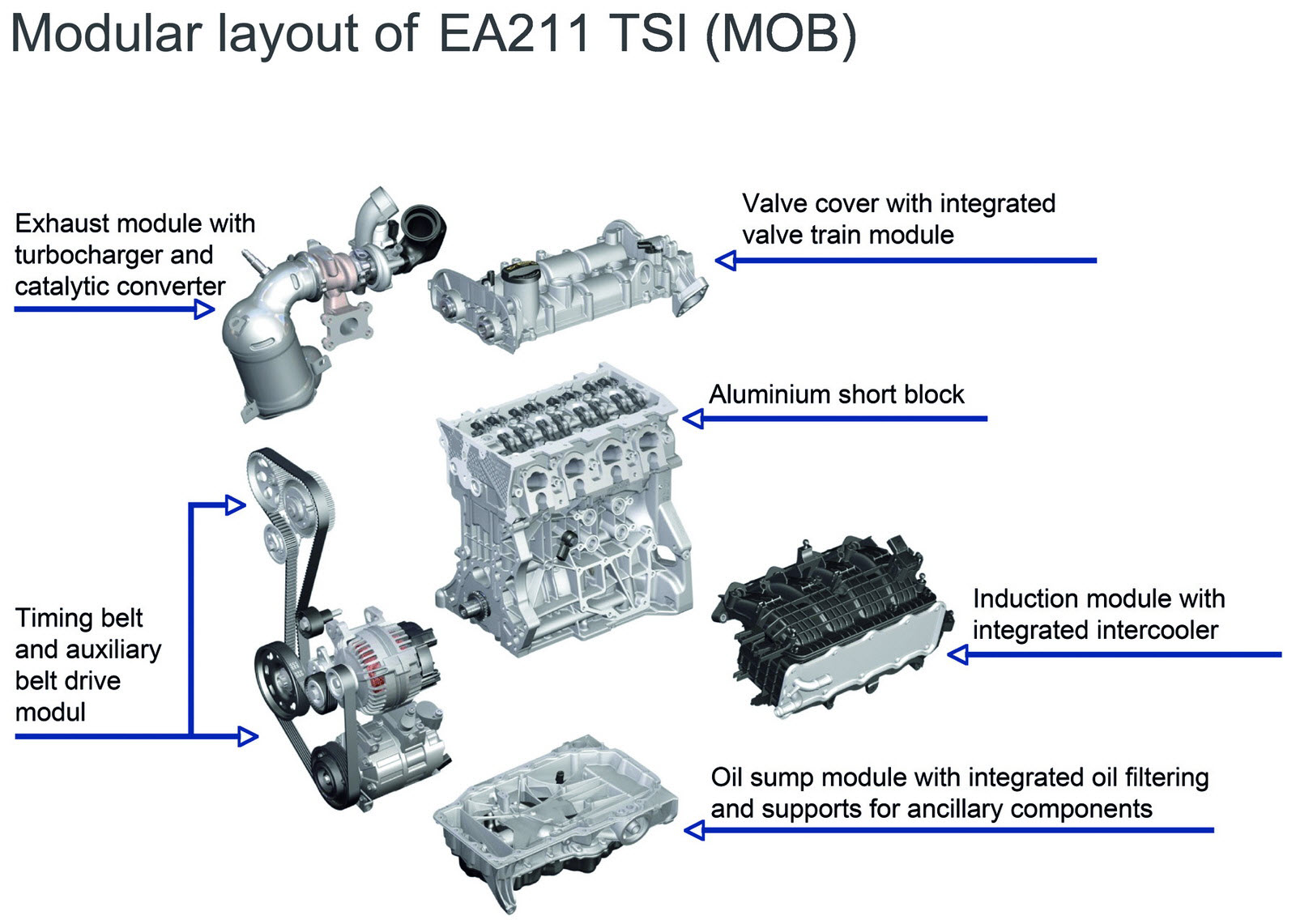
One of the prominent characteristics of the Modular Transverse Matrix is the uniform mounting position of all engines. Two systems integrated in the MQB strategy which play a key role here are the modular petrol engine system (MOB) with the new EA211 engine series (40 kW / 60 PS to 110 kW / 150 PS) – this range includes the world’s first four-cylinder engine with cylinder deactivation (ACT) – and the modular diesel engine system (MDB) with the also new EA288 engine series (66 kW / 90 PS to 140 kW / 190 PS). In one fell swoop, the new engine series will reduce the Group’s engine and gearbox variants in the MQB system by approximately 90 per cent. Without any negative effects. On the contrary, in addition to standardising conventional internal combustion engines, the MQB also enables an identical mounting position for all current alternative drive concepts without limitations – from natural gas and hybrid versions to the pure electric drive. Volkswagen has already announced the launch of the latter within the MQB in 2013 in the new Golf Blue-e-Motion.

The MQB opens up new opportunities at Volkswagen Group, allowing it to produce high-volume and niche models at the highest quality and extremely competitive costs over the long term and worldwide – vehicles that are individually tailored to the requirements of very diverse markets such as Europe, China and America, as well as emerging markets such as India. In parallel, Volkswagen Group will significantly reduce vehicle weights with the launch of the first MQB model series and will introduce 20 innovations in the areas of safety and infotainment, which until now were reserved for higher vehicle segments.


They include the new multicollision brake; after an initial collision, it helps to reduce the intensity of secondary collisions by automatically initiated braking. Very recently, ADAC awarded this system the ‘Yellow Angel’ award for innovations. The multicollision brake will be standard equipment in the next generations of the Audi A3 and the Golf.

Within the Group, the MQB developed under the auspices of the Volkswagen brand is supplemented by the Modular Longitudinal System (MLB) from Audi, the Modular Standard System (MSB) with Porsche as the competence centre and finally the ‘New Small Family’ – the most compact vehicle model series with the Volkswagen up!, SEAT Mii and ŠKODA Citigo.

One indicator of the pioneering significance of the modular systems strategy and the innovative potential realised by these new vehicle and production architectures is that Volkswagen was selected as one of five finalists for the ‘Innovation Award of the German Economy – The World’s First Innovation Award®’ for its Modular Transverse Matrix. This prestigious award for outstanding technical, scientific and intellectual achievements has been awarded annually since 1980 by the Economics Club of Rhein-Main and since 2011 in conjunction with the newspaper Frankfurter Allgemeine Zeitung. On 11 February, the prize winners will be announced at the Palais 'Thurn und Taxis' in Frankfurt, Germany, by Günther Oettinger, EU Commissar for Energy. The anticipation grows!


Images : Volkswagen's Modular Transverse Matrix (MQB)


[Source : VOLKSWAGEN]

Ford's 1.0-litre EcoBoost turbo petrol engine debuts in all-new focus

1.0-litre Ford EcoBoost turbo petrol engine
  • Unique new 1.0-litre EcoBoost petrol engine offered across Ford Focus range
  • Up to 125PS – same as 1.6 naturally-aspirated engine
  • Fuel economy of up to 58.9mpg
  • CO2 emissions as low as 109g/km, resulting in zero road tax (VED) in first year
  • Maximum engine torque of 170Nm between 1,400 and 4,500rpm exceeds 1.6-litre for excellent drivability
  • Developed by UK-based engineers at Dunton and Dagenham
BRENTWOOD, UK : January 30, 2012 – Ford’s high tech, ultra-efficient, turbocharged, direct injection 1.0-litre EcoBoost engine goes on sale across the Ford Focus range in the UK next month.  This unique, industry-first EcoBoost engine delivers performance to rival a traditional 1.6-litre engine with significantly improved fuel efficiency and class-leading ultra-low CO2 emissions.

2012 Ford Focus

The 1.0-litre, three-cylinder EcoBoost engine is available with two power levels – in the five-door Focus at 125PS it delivers a combined fuel economy of 56.5mpg and low petrol CO2 emissions of 114g/km (a level unmatched by Focus competitors with similar power outputs), while the 100PS version delivers a combined fuel economy of 58.9mpg and outright best-in-class petrol CO2 emissions of 109g/km.

Around 200 UK engineers based at Dunton and Dagenham successfully developed a powertrain which not only leads on fuel economy but also delivers the refined and spirited driving performance that customers have come to expect from Ford.

Though the 1.0-litre EcoBoost cylinder block can fit onto a sheet of A4 paper it delivers up to 125PS and 170Nm peak torque (200Nm with overboost) between 1,400 and 4,500rpm, giving it the highest power density of any Ford production engine to date.

Graham Hoare, European executive powertrain director based at Dunton, said:  "This is the third addition to our acclaimed EcoBoost engine family.  Joining the 1.6-litre and 2.0-litre EcoBoost engines which span 150PS to 240PS, this 1.0-litre EcoBoost signals a new era of downsized, super frugal engines for the sub-130PS segment.  During development our UK engineers focused onimproving thermal efficiency and reducing friction of the engine's internal moving parts, especially during warm-up."

Customer savings


In addition to the customer benefits resulting from improved fuel consumption and petrol being up to 10p per litre cheaper than diesel, the lower CO2 emissions translate into direct customer savings.  The 100PS and 125PS version will both qualify for zero vehicle excise duty in the first year and then £20 (100PS) and £30 (125PS) per annum thereafter.  Compared with the current 1.6-litre 105PS and 125PS engines, this represents savings of £115 in year one and £95 and £85 respectively in subsequent years.

Company car drivers will see attractive benefit-in-kind rates of only 13 per cent in 2012/2013 equating to savings on a Focus Zetec of up to £32 per month at the 40 per cent tax level versus the current 1.6-litre 105 and 125PS engines.

Mark Ovenden, Ford Britain managing director, said: “Gone are the days when the number of cylinders dictates performance.  This highly efficient, technically advanced powertrain is not only great fun to drive, but it delivers fuel economy improvements and ultra-low CO2 emissions which lead to real world cost savings for our customers.”

New Ford Focus range is priced from £13,995 on the road.  The latest price list, effective 22 February 2012, introducing Focus with the 1.0-litre EcoBoost engine, is attached.  This engine is priced £250 (on the road) above the 1.6-litre 125PS engine and will subsequently feature in Ford C-MAX, Grand C-MAX and all-new Ford B-MAX later this year.

[Source : FORD]

Audi updates A5 with the new 1.8 TFSI engine


2012 AUDI A5

  • Ample power and minimal consumption: 125 kW (170 hp) and 320 Nm (236.02 lb-ft) torque, but just 5.7 liters per 100 km (41.27 US mpg)
  • New solutions in fuel injection and other fields of technology
  • Fully electronic coolant regulation system
INGOLSTADT : August 4, 2011 - The engines in the updated A5 family set new standards for sportiness and efficiency. Even the base engine, the completely redesigned 1.8 TFSI, showcases the full extent of Audi’s technological competence. The engineers have developed innovative solutions in numerous fields of technology to achieve surprisingly strong performance with minimal fuel consumption.


2012 Audi 1.8 TFSI Engine

The high-end four-cylinder engine displaces 1,798 cm3 and delivers a brawny and constant 320 Nm (236.02 lb-ft) to the crankshaft between 1,400 and 3,700 rpm. Peak output of 125 kW (170 hp) is achieved at 3,800 rpm. With a manual transmission, the 1.8 TFSI accelerates the Audi A5 Coupé from zero to 100 km/h (62.14 mph) in 7.9 seconds on its way to a top speed of 230 km/h (142.92 mph). Despite all this power, it consumes just 5.7 liters of fuel per 100 km (41.27 US mpg) on average, which corresponds to best-in-segment emissions of 134 grams of CO2/km (215.65 g/mile). Consumption has been reduced by 21 percent compared with the previous model engine.

Combustion behavior was a particular focus of the development work. In addition to FSI direct injection, the 1.8 TFSI also uses indirect injection. This system injects the fuel at the end of the intake manifold near the tumble valves, where it is swirled intensively with the air. Indirect injection is used in the part-load range. It reduces fuel consumption and particulate emissions to such an extent that the four-cylinder engine already complies with the limits of the future Euro 6 standard, which does not enter into force until 2015.

The rail pressure of the FSI system has been increased from 150 to 200 bar. The direct injection system is active when starting off and at higher loads. It can perform two or three individual injection operations per work cycle. To further optimize gas exchange, the valve control system has been given greater operating freedom. The Audi valvelift system, which adjusts the lift of the valves in two stages, is active on the exhaust side. The two camshafts can be adjusted through 30 or 60 degrees of crankshaft angle.

Fully electronic coolant regulation system

The innovative thermal management of the four-cylinder engine features a new fully electronic coolant regulation system. Two fast-switching, rotating cores, which are consolidated in a module and driven by an electric motor via a screw drive, control the flow of coolant. One of their primary objectives is to bring the motor oil up to operating temperature as quickly as possible following a cold start. This is done by keeping the coolant in the crankcase for a relatively long time. The cabin heating runs off of a separate loop in the cylinder head. The main radiator, which dissipates the heat to the environment, does not come into play until the latest possible moment.

The new rotating core module can set the water temperature between 85 and 107 degrees Celsius as a function of load and rpm to always achieve the best compromise between minimal internal friction and thermodynamic efficiency. Switchable valves throughout the cooling system manage heat flows between the engine, the heat exchanger for the transmission and the cabin. All together, the thermal management system reduces the CO2 emissions of the 1.8 TFSI by around 2.5 g per 100 km (4.02 g/mile).

This concept benefited from the integration of the exhaust manifold into the water-cooled cylinder head. Because this also reduces the exhaust gas temperature, it is not necessary with the 1.8 TFSI to enrich the mixture at full load, which reduces fuel consumption significantly when driving sportily.

The turbocharger in the 1.8 TFSI is also an all-new design that develops the high relative boost pressure of up to 1.3 bar very systematically. Key features include a turbine wheel made from a new alloy that can withstand exhaust temperatures of up to 980 degrees Celsius, the oxygen sensor mounted directly upstream of the turbine wheel, a pulsation damper, a compressor wheel machined from a solid blank and an electric wastegate actuator that adjusts the boost pressure particularly quickly and precisely to further reduce fuel consumption.

Engine weight has been reduced from 135 to 131.5 kilograms (297.62 to 289.91 lb). The new turbocharger/cylinder head module, a new casting process for the gray cast iron crankcase that reduces wall thickness to roughly three millimeters (0.12 in) and the crankshaft with four rather than eight counterweights and reduced main bearing diameters all contributed to this weight reduction. The pistons are made of new, high-strength alloy. Lightweight polymers are used for the oil pan, and many screws are made of aluminum.

Internal friction has also been drastically reduced by the use of an innovative coating on the piston skirts and by mounting the two balance shafts that counteract the second-order inertial forces in roller bearings. The regulated oil pump requires little energy itself, and the oil-jet cooling for the piston heads is controlled via a high-precision electric system.

[Source : AUDI]